
Olives
Almonds probably originated in today’s Iran.
They reached Sardinia in prehistoric times
and are today ubiquitous on the island.
Order in Shop


Products Almonds, Chickpeas
Location: Tuili
Extension: 30 ha (13 with almonds, the rest either wheat, chickpeas or fallow, on rotation)
Employs: Himself (his father and a seasonal worker help during harvest)
Antonio Vinci helps a large Sardinian company manage its real estate during mornings. In the afternoons, he grows certified organic almonds and chickpeas on some 30 ha of land.
This lays on the slopes of the giara manna – the largest of a series of basalt plateaus that characterize central-southern Sardinia – and on the plain that extends at its southern end.
The first almond trees were planted by his father, a sheep shepherd, in 2008. In 2014, Antonio started planting more trees, and their number is still growing.
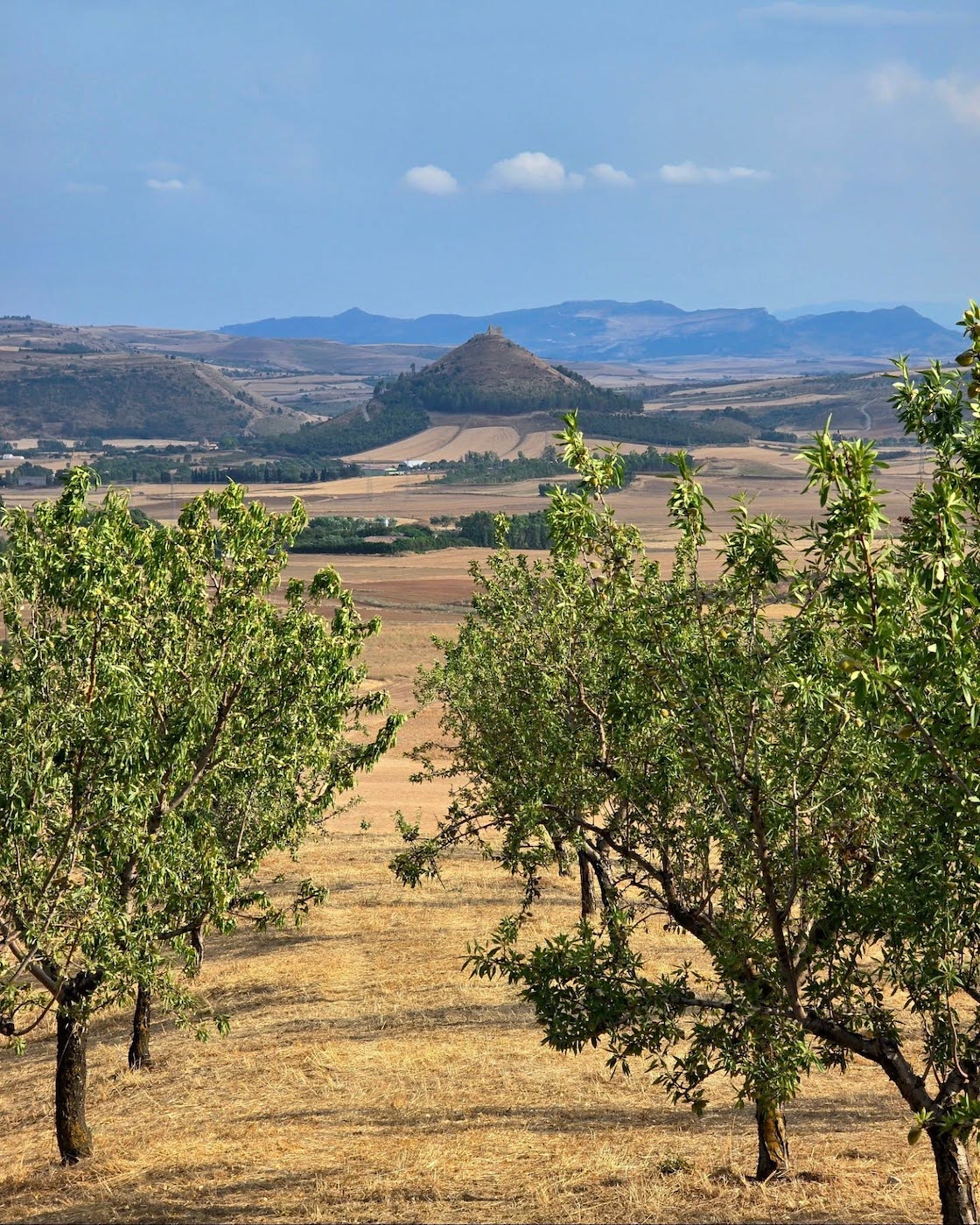
The ruins of las Plassas castle, seen through Antonio’s almond trees.
Author: Antonio Vinci
© Antonio Vinci
He grows almonds of two Italian varieties: Genco and Tuono, spaced 5 to 6 meters apart.
Trees are not irrigated, and the only work on the soil – aside for the ripping and evening before establishing a new plantation – is grass cutting. This work is carried on with a mower attached to a tractor. The trees are pruned each year to control their size and promote vigorous new growth.
The cultivation is certified organic. He fertilizes the plants every few years, to integrate phosphorus and micronutrients. He also applies copper and sulphur once a year on the leafless plants, to prevent fungal attacks. On some instances he has used Spinosad (an insecticide obtained from a bacterium, allowed in organic farming) to fight some pests.
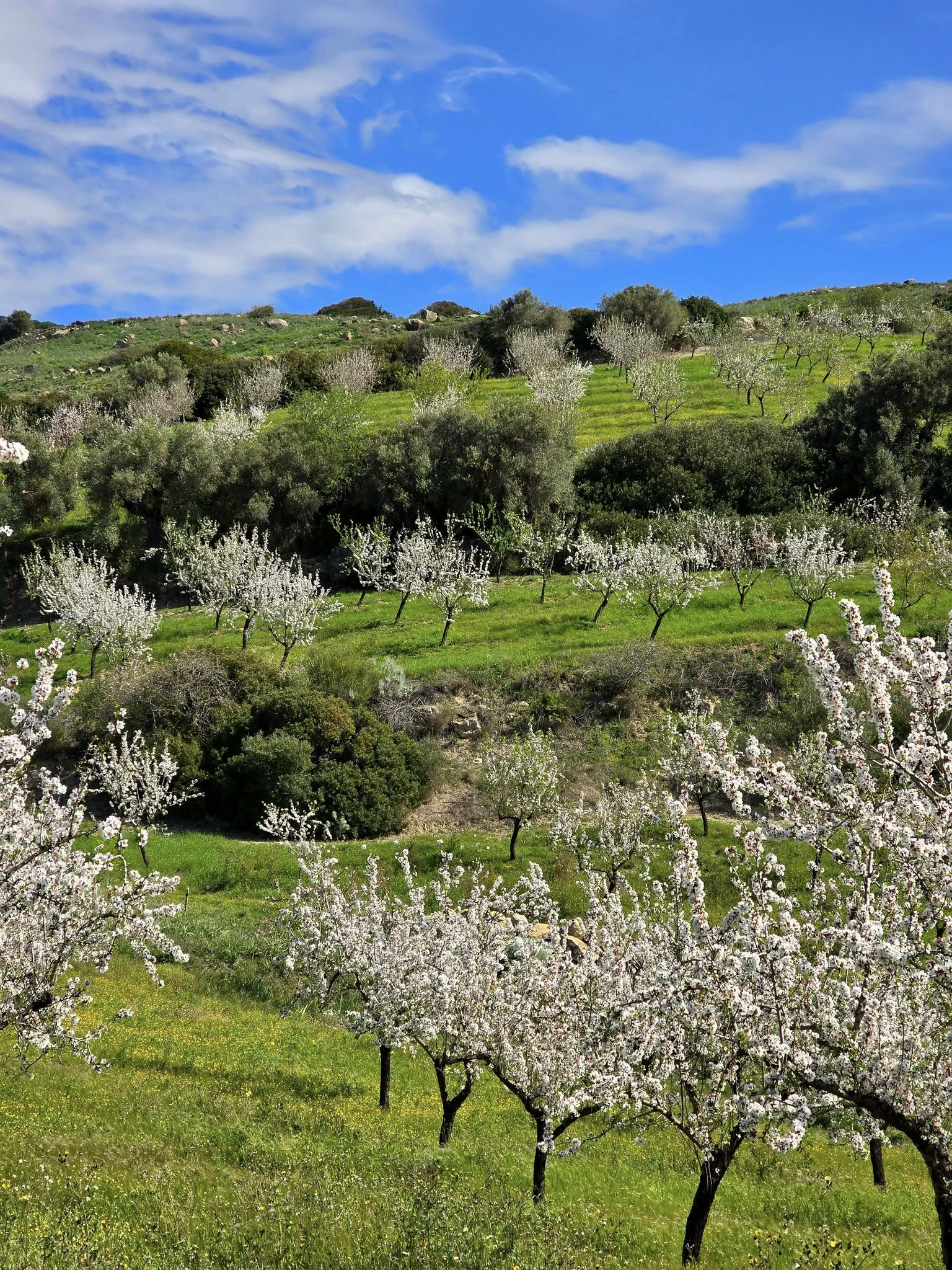
Almond trees of various ages on the slopes of the giara manna.
Author: Antonio Vinci
© Antonio Vinci
Harvesting is carried with manual shakers, and also with a tree-shaker mounted on wheels. Drying and shelling of the harvested almonds are mechanized. In a good year, he manages to produce some 100’000 kg of edible nuts.

The automatic harvester in action. The machine cannot handle all slopes, and Antonio’s father often prefers to use the manual shakers even on plots the machine could reach.
Author:
©
On his flatter plots, he applies a three-year crop rotation, alternating wheat, chickpeas and fallow. All work here is carried out with the help of a tractor, from soil preparation, to seeding, to harvest. No weeding is practiced, as the chickpeas eventually smolder the other plants.
Harvested chickpeas are cleaned automatically and then sorted by a machine, to discard impurities and poor quality seeds.
One of Antonio’s chickpea fields in …
Author: Antonio Vinci
© Antonio Vinci
Antonio was able to set up his enterprise and buy most of his machines thanks to bank loans and EU funds. At the moment, through the sales of his produce, he is able to repay production costs and loans.
He would like to soon dedicate all his time to his land, growing crops, but also building and managing an agriturismo together with his partner.
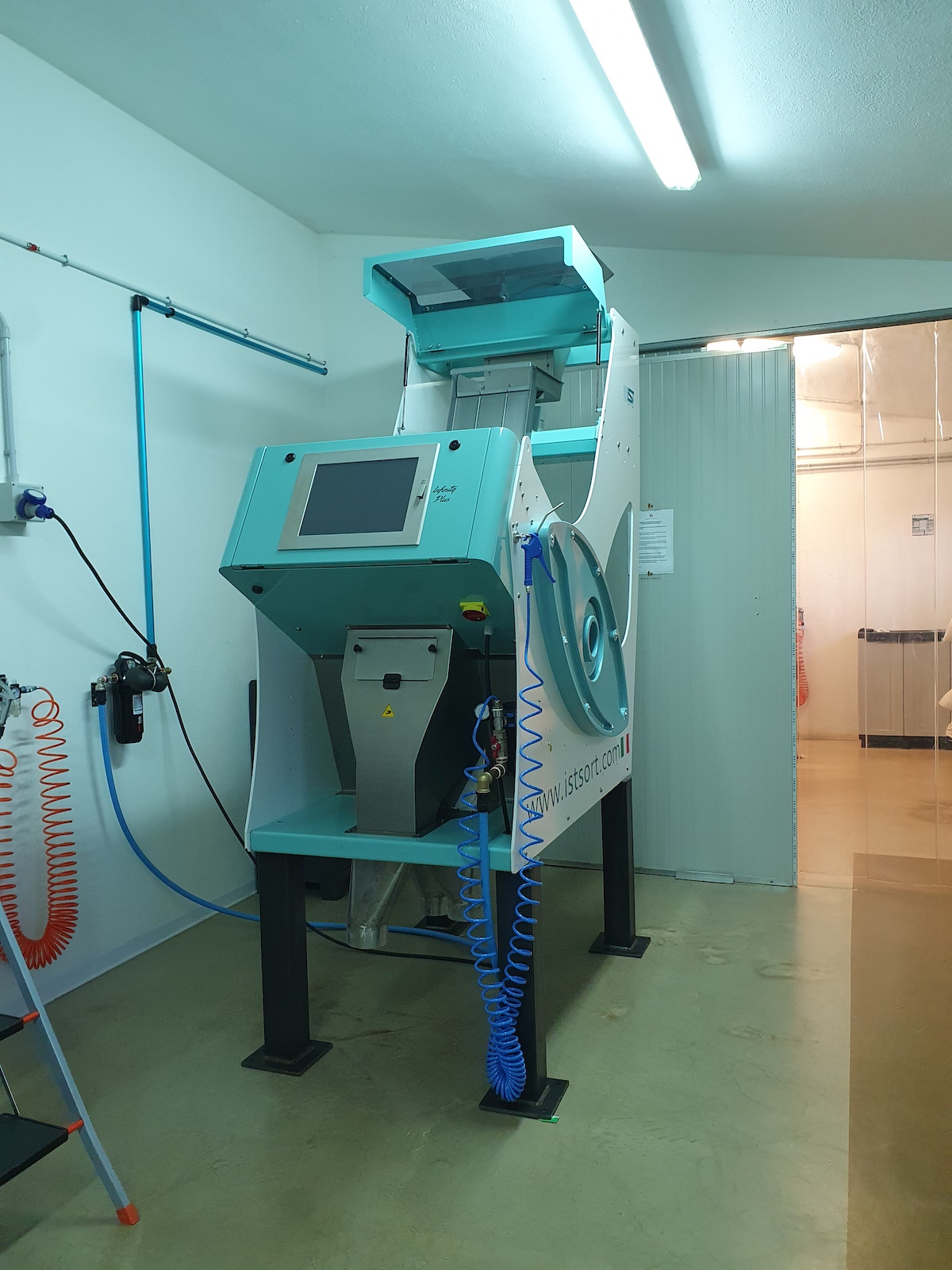
The optical sorting machine for chickpeas, in Antonio’s laboratory.
Author: Peppe Congiu
© Aristeu
Almonds probably originated in today’s Iran.
They reached Sardinia in prehistoric times
and are today ubiquitous on the island.
Almonds probably originated in today’s Iran.
They reached Sardinia in prehistoric times
and are today ubiquitous on the island.
Almonds probably originated in today’s Iran.
They reached Sardinia in prehistoric times
and are today ubiquitous on the island.
Almonds probably originated in today’s Iran.
They reached Sardinia in prehistoric times
and are today ubiquitous on the island.
Almonds probably originated in today’s Iran.
They reached Sardinia in prehistoric times
and are today ubiquitous on the island.
Almonds probably originated in today’s Iran.
They reached Sardinia in prehistoric times
and are today ubiquitous on the island.
Almonds probably originated in today’s Iran.
They reached Sardinia in prehistoric times
and are today ubiquitous on the island.
Almonds probably originated in today’s Iran.
They reached Sardinia in prehistoric times
and are today ubiquitous on the island.
Almonds probably originated in today’s Iran.
They reached Sardinia in prehistoric times
and are today ubiquitous on the island.
Almonds probably originated in today’s Iran.
They reached Sardinia in prehistoric times
and are today ubiquitous on the island.
Almonds probably originated in today’s Iran.
They reached Sardinia in prehistoric times
and are today ubiquitous on the island.