
Capers
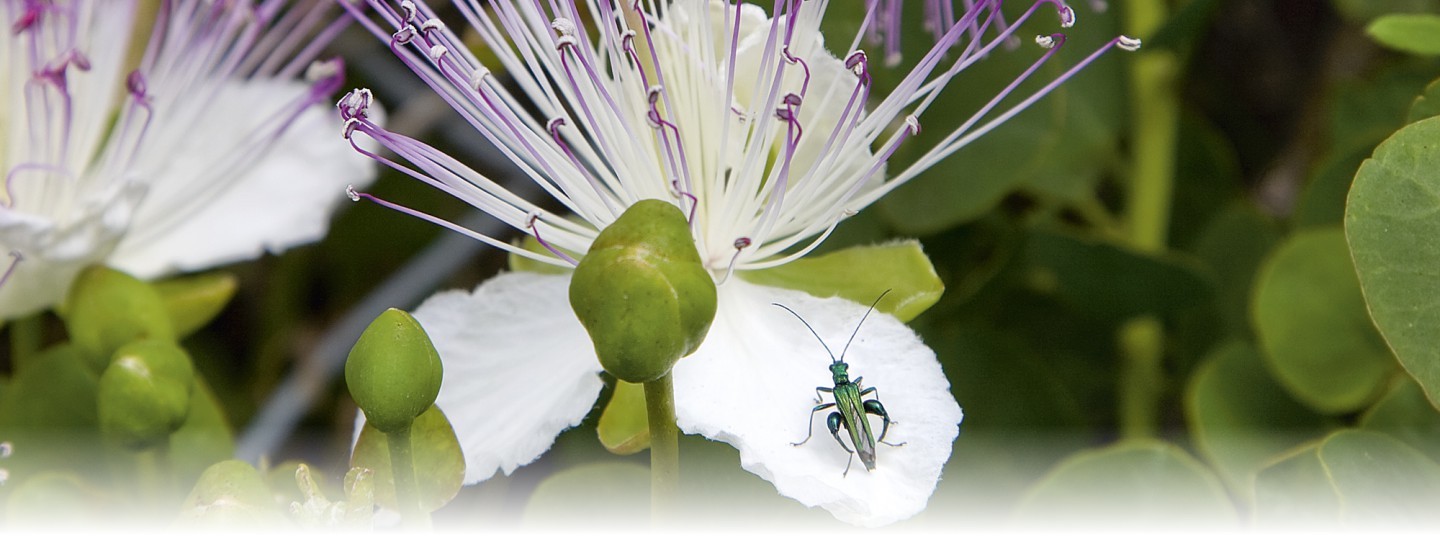
On the island, capers grow wild in a few locations with limestone rich soils. A very rustic plant, it grows in rock crevices and on walls: huge plants festoon the fortifications in the capital city.
Locally, the plant was used as popular remedy for treating ulcers of the skin, and the floral buttons and the fruits were sparsely consumed.
Cultivation on a larger scale started in the late XIX century, in the town of Ceraxius (“c” = the Spanish “ch”, “x” = the French “j”), to supply the medicinal and culinary markets.

Capers on the medieval walls of Casteddu de susu, the acropolis of the capital city, Casteddu.
Author:
©
Rather than through rock and mortar, here the plants can send their roots through deep, fairly fertile loamy soil. The clay content is surprisingly high, but clearly does not discourage this plant that thrives in fast draining, often vertical surfaces.
Instead, capers grow vigorously on these flat expands, but require some cultural practices to stay compact and so that air can circulate among their branches and at the foot of the plant.
They are a perennial and long lived plant, and are pruned heavily at the end of the growing season, in early autumn. CHECK THIS ONE!!! All the shoots of the year are pruned back heavily, leaving brief twisted lignified stumps, surmounting a short trunk, which is left free of ramifications for some 30 cm, to ensure air circulation at the foot.
Caper shrub in March. Pruned and during the winter sleep. The plant is leafless because has been pruned. Capers stay evergreen in southern Sardinia, and one can see new reddish growth in the picture.
The woody stumps that are left host a mat of lichens.
Author: Aristeu
© Aristeu
During the harvesting season (usually from May to early July). The floral buttons have to be harvested regularly, as they mature, often two or three times per week for every plant, preferably in the early morning, when the turgid petioles snap more easily. If a plant sets flower, the energy will be redirected to these, compromising the flush of new buttons and reducing the harvest. Harvesting can only be carried out by hand. A skilled harvester can pick some 3-5 kg per hour.
In the last dryer years, plants profit from one or two irrigations before and during the harvest season, as this improves yield and quality. During the same time, plants have to be monitored and protected from the cabbage butterfly CHECK ENGLISH NAME. If a NIDIATA hatches, caterpillars can defoliate an entire plant, and AZZERARE its yield. Hand removal of the eggs and larvae is the best method. Probably, the entirety of capers cultivation in Sardinia is done organically, though most is done by hobbyists and is not certified.
Caterpillar and eggs of cabbage white butterfly on a caper leaf.
Author: Aristeu
© Aristeu
The first buttons appear in may and are “stained in red” (present a red colour on the bracts that envelope the floral bud). These are locally more prized and are usually preserved in vinegar, to be used in preparations where the taste ought to be tempered. Harvested capers are spread and left in a ventilated space for one to three days and then are placed in jars and covered with vinegar. This has to be changed with new vinegar about one month in.
The capers are else preserved in salt. After spreading and leaving in the air, equal weights of salt and capers are mixed. Some let the mix sit untouched: the buttons appear whole and are wetter, the product is ready after HOW MANY MONTHS? Others let the water and the dissolved salt drain, and turn the mix every few weeks for the first XXX MONTHS. Most of the buttons break or are loosened in the process. The obtained product is dryer and yields are about half than with the other method. The salt grains detach more easily from the capers, that can be shaken on a colander rather than washed, loosing less flavour in the process.

Shoots at the beginning of the harvest season, in May. These will become 2-3 meters long in the course of the growing season.
Author: Aristeu
© Aristeu
Today Ceraxius, on the capital’s outskirts, has lost a lot of its agricultural land to urban sprawling. The labour intensive capers cultivation was mostly abandoned and many bushes got ripped out to leave space for other cultures. Still, many old plants dot the fields and fringe spaces at the periphery of the town.
In recent years, the renewed interest for- and increased value of capers, and the will to preserve a local peculiarity, have brought some farmers to revive this production, often managing scattered plants in odd plots apart, with the permission of the owners.