
Dried Tomatoes

Almonds probably originated in today’s Iran. They reached Sardinia in prehistoric times and are today ubiquitous on the island.
One can spot old trees and naturalized specimens in what are today abandoned agrarian landscapes, especially in February, when they normally flower.
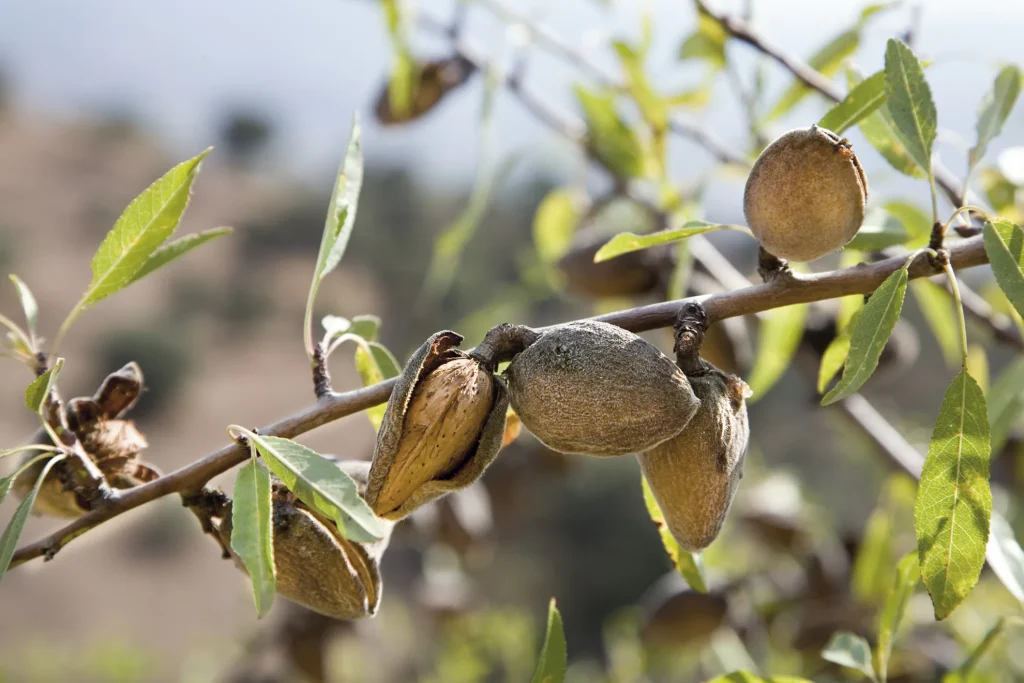
They were often planted on the edges of plots, or sparsely in vineyards, or again in mixed polycultures with olive trees. Today, these scattered trees are often left unharvested and the almonds, ripe around August/September, stay on the branches, so that come Spring one can see the new crop hanging next to the old fruits.

Vineyards and recent olive grooves in Ozzastra, with almond trees bordering the plots edges.
Author: Aurelio Candido
© Aurelio Candido
Sardinian varieties produce shells of changing sizes, so automating the cracking of the shell and the separation of the inner seed is challenging. This, together with the scattered distribution of the plants and their often considerable size, limits the possibilities to exploit the plants economically.
Vineyards and recent olive grooves in Ozzastra, with almond trees bordering the plots edges.
Author: Aurelio Candido
© Aurelio Candido
In latter years, more farmers have started new, small plantations with Italian, Sicilian and Spanish selections. These offer higher yields, and a more constant quality and size of the fruits. Sardinian universities have started promoting the rediscovery of local varieties, but their use for new plantations is limited by the availability of the propagation material.
In some areas, the old trees are still harvested, and the almonds – often cracked and cleaned by hand – sold in local markets.
In Ulíana an interesting experiment was attempted by Giovanni Carente, with his company Chivu: he invested in a machine to clean the almonds and bought the shelled almonds from small farmers, who still had trees on their properties. Unfortunately the company closed a few years ago, due to economic difficulties.
Vineyards and recent olive grooves in Ozzastra, with almond trees bordering the plots edges.
Author: Aurelio Candido
© Aurelio Candido
Almond production in Sardinia is oriented towards the internal market. The demand is high, especially because of the role of almonds in traditional pastry, where they are one of the four or five main ingredients.
Ground, they are transformed in light marzipan, flavored with lemon and orange peels or with liqueurs. In coarser chips, they are used to garnish and decorate several creations, or as the main ingredient in gattó and timballas.

Ripe almonds on a branch.
Author: Nelly Dietzel
© Ilisso Edizioni